As we look through the history of art, we see that many people pursue their dreams, but not everyone gets the opportunity to transform their passion into a profession. Among those who have lived their passion throughout their lives is Tariq Gill, who discovered his enthusiasm for art, particularly drawing, painting and sculpture, at a young age.
Tariq Gill was born in Lahore, Pakistan, in 1957. From an early age, he developed a strong interest in drawing and art. However, at the time, pursuing art as a profession was not widely encouraged, and his family initially discouraged him from studying Fine Arts. As a result, he began studying B.Sc. Chemistry and also worked in a chemical factory. Despite these circumstances, he remained committed to his passion for art.
In 1977–78, while studying Chemistry and working at the chemical factory, he joined Alhamra Arts Council, Lahore, for drawing classes. There, he was taught and trained by Khalid Iqbal, Colin David, and Naseem Abdul Hafeez Qazi, whose guidance contributed to his early artistic development. His studies and experience in Chemistry also became valuable to his artistic practice, particularly in understanding and experimenting with pigments, colours and different types of paints, including oil and casein paints. In some of his paintings, he later used paints that he prepared himself.
As his dedication to art grew, Gill continued developing his practice through extensive drawing, painting and independent study. In 1983, he joined the National College of Arts (NCA), Lahore, to formally pursue his passion for Fine Arts. He studied at NCA from 1983 to 1988, further developing his practice in drawing, painting and sculpture.
During his years at the National College of Arts, Tariq Gill developed close relationships with several of Pakistan’s leading artists and teachers. Mian Salahuddin and Colin David were among his teachers, while Zahoor ul Akhlaq took a particular interest in his work and arranged a meeting with Salima Hashmi for Gill’s first solo exhibition at Rohtas 2 Gallery. Iqbal Hussain offered Gill the use of his studio while he was away in France. During his student years, Gill also brought art materials and paints from the United States for Iqbal Hussain, as Gill’s elder sister was based there. Before choosing sculpture as his BFA major, Gill visited Shah Sajjad’s studio in 1985 to explore the discipline. He also met Ali Imam at Indus Gallery, where they discussed art and the broader art world, and visited Rabia Zuberi at her home and studio, where he encountered her sculptural work. His wider artistic circle included Askari Mian Irani, Tanveer Murshid, Mahmood ul Hassan Jaffery, Saeed Akhtar, Muhammad Asif, and Ahmad Khan, with whom he shared studio discussions, collaborative work, and artistic exchanges. In 1985, Gill also worked with Saeed Akhtar, Muhammad Asif, Ahmad Khan and Mian Salahuddin on a sculpture of Quaid-e-Azam. Alys Faiz later described Gill as a “Labour-Artist” in Viewpoint following his 1988 thesis exhibition, reflecting his earlier experience in the chemical industry.
Gill undertook numerous commissioned and collaborative projects during and after his college years. These included a Lahore Zoo sculpture created as part of a team in 1986; a Quaid-e-Azam sculpture produced through a collaborative team effort in 1986; a mural painting for Freemasons Hall, Lahore, in 1987; and the Fortress Stadium “Float and Stall” project, including themes of Kashmir, Forest and Zoo, in 1987. In 1992, he created seven 2 × 2-foot mural sculptural relief panels for Nishat Centre.
His later projects included a 6 × 62-foot mural painting for a local McDonald’s franchise, completed as a one-man project in a record 18 days—nine days of research, composition and drawing, followed by nine days of painting. In 2004, he created a sculptural relief portrait of Fatima Jinnah for Madar-i-Millat Park, Nazaria-i-Pakistan, The Mall, Lahore. In 2011, he created 200 masks for former Governor of Punjab Salman Taseer for a New Year’s event.
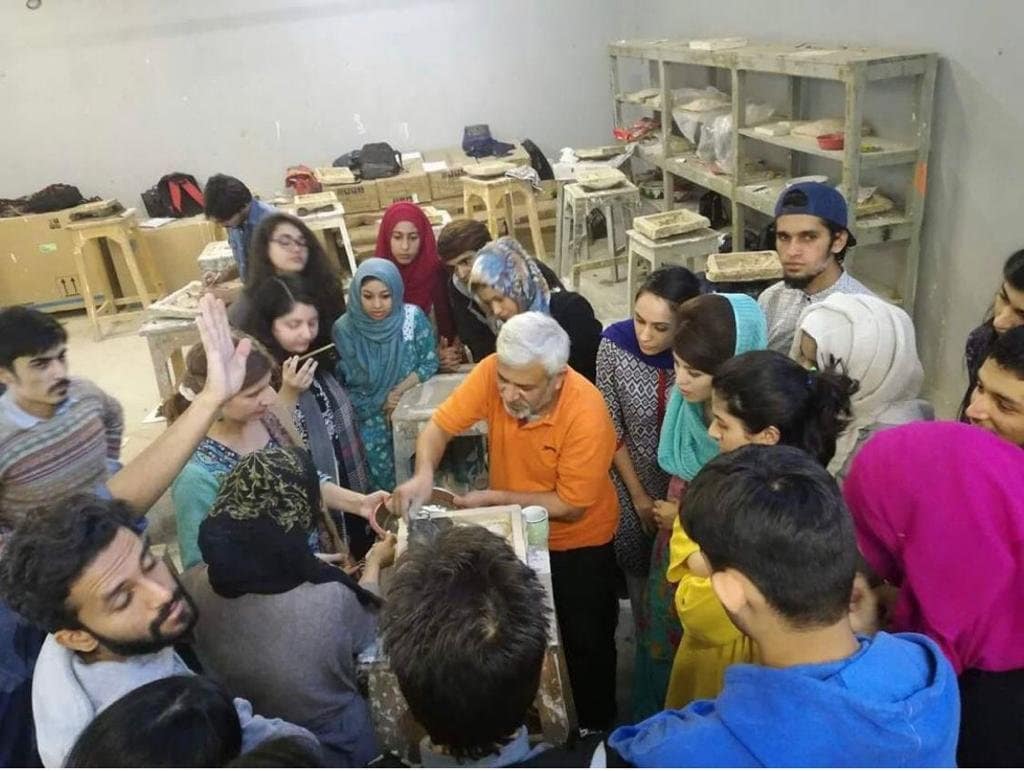
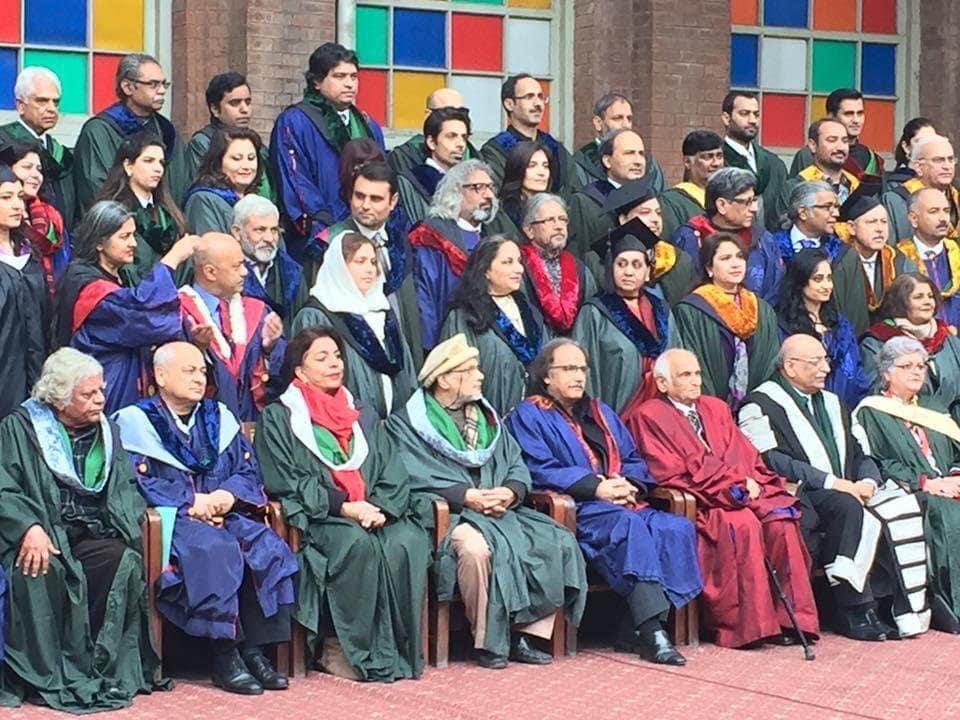
Throughout the 1970s, 1980s and 1990s, Gill continued to develop his artistic practice through extensive work in his Lahore studio. In 2000, he began teaching ceramics, sculpture, drawing, painting and printmaking at Hunerkada College of Visual and Performing Arts. In 2004, he was invited to join the National College of Arts (NCA), Lahore, as an Assistant Professor, where he taught drawing, painting and sculpture at different levels, including BFA and Master’s programmes. He later served as an Associate Professor and retired from NCA in 2019.
Although retired from formal teaching, Gill has remained connected to academic and artistic institutions and has frequently been invited to participate in discussions, juries, evaluations, markings and workshops. His academic engagements include jury and marking of annual work at CMH Hospital, Lahore (2017); a two-day workshop at Fountain House, Lahore (2017); evaluation and marking of Ph.D. Part I at Coopera Gallery, Lahore (2016); jury and marking of M.Phil at Punjab University, Lahore (2016); jury of Bachelor’s and Master’s students at Fatima Jinnah Women University, Islamabad (2013); discussion on Ph.D. students’ displays at Punjab University, Lahore (2010); jury and marking of Bachelor’s students at Multan College of Arts, Bahauddin Zakariya University, Multan (2010); discussions with Ph.D. students at Minhas Gallery, Lahore (2009); a ten-day workshop on traditional ink-making techniques, Arzang-e-Cheen, for M.A. students at NCA with Ustad Khursheed Gohar Qalam (2006); and an introduction to ceramics and working with clay at Idara Bahali-e-Mazuran, Lahore (2004).
His exhibition history, including solo and group exhibitions, is documented separately on the Exhibitions page.
Concept & Practice
Tariq Gill’s artistic practice spans nearly five decades, rooted in an ongoing exploration of imagination, perception, and the unseen dimensions of everyday life. What he observes in his surroundings often reveals itself in ways that may be visible only to him—visions emerging from shadows, marks, and accidental forms on surfaces. These moments trigger his imagination and evolve into visual narratives shaped by the literature he reads, the dreams he experiences both in sleep and in waking life, and the fleeting impressions formed while observing the world around him.